I sometimes wonder why in 2014 I suddenly found myself creating music, why I bought an acoustic Ashbury cittern on a whim, and why that day it seemed to play me in Hobgoblin Music , not the other way round. You can call it a calling, but if it was that it took a very long time coming, because I’ve enjoyed music, played guitar, and been involved with music to a lesser or greater degree since childhood.
I don’t tend to psychoanalyse much of what I do. I just get on with it “There are those who do and those who don’t but we just did” is the motto by which I live life. Just like these blogs and writings long before, a body of material builds up. You can look at it as a kind of diary, but I’d rather look at it as something with a purpose: a means to an end, even if I don’t yet know what that end may be. So the blog mixes personal experience with campaigning, the odd rant, and offering support for my fellow independent musicians.
Some of you will know that the first song for Nightsong’s “The Peasants’ Revolt” came from a print I’d bought in Norfolk in the 1990s from one of my favourite pubs on earth in one of my favourite villages on earth. I was first taken to Castle Acre in Norfolk on a Landscape Archeology field trip with the wonderfully inspiring Alan Carter, and followed it up with a number of student trips out: walks in the medieval castle and priory grounds and around the village walls. Experiences like that stay with you, and their importance resurfaces at precisely the time they’re meant to. Thus, “Pauper’s Son” was written in 2019.
Fast forward to January 2022, and on one of our first walks down the hill after moving to Berwick I noticed an information board situated by a gap between two large houses. It’s the remains of St. Leonard’s church from where Edward I (Longshanks) oversaw the sacking of Berwick Castle in 1333. Farther up the same hill is the site of St. Leonard’s Nunnery, in a field by the A1.
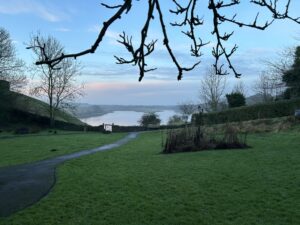
A little farther down the hill is the gate to Coronation Park which overlooks the River Tweed, with the castle remains on the hill above. Near the top of the winding path down to the river there’s a memorial to the last person hanged in the town. Grace Griffin was sentenced to death after murdering her pub landlord husband, although evidence was at best circumstantial and witnesses dubious. Originally intended for a second Nightsong album, “Murder Of Grace” was the starting gun for “Borders, Battles & Bounds”, which is still a work in progress. Sometimes it pays to wait for the right spark, the right time to start, resume, or complete a piece of work. However, when the messages keeps coming, there’s also a need to fulfil the promise you made to yourself, to finish what you started.
Then just last week, I was approached by talented local illustrator Alison Edwards, to write a folk song at very short notice, then perform it at the end of March. The Jacobite Rebellion story I was provided with is hilarious, and has led to two further songs being put into the same project. During our conversations, I mentioned “Borders, Battles & Bounds”, and that I was looking for a few more stories about the ordinary lives of women in Berwickshire and North Northumberland. I was put in contact with the Project Director of ‘The Wilson’s Tales’, who happens to have about 450 I can draw from! Things are getting very interesting.
On 10th March, I drive south for a fleeting visit to my old stomping ground to record the fabulous voices of Emma Perry and Kate Ferris who have kindly agreed to add backing vocals to an 11-minute folk song. I’ve been working on it since the tail end of last year, when a Rochdale videographer and local historian asked for permission to use my song “Watergrove Farm” to back one of his videos. In return, he gave me permission to write a song about one of the stories he’d collected from the area. That song is about the life of a ‘lime gal’ who worked in the Wardle Valley near Rochdale…which was partly inundated by Watergrove Reservoir, the subject of “Watergrove Farm”, the second song on my “Moorscape” album.
So, forget the histories of the lords, ladies, kings, queens, and bishops who liked to write their histories only from their own perspectives and agendas. It appears that the interpretation and re-telling of the histories of real people has become something of a vocation. Apart from being inspiring, interesting and enjoyable, it feels like we all need reminding from time to time that our own histories may one day be related by our descendants. Some of these stories might fade from existence if they are not re-told, and many are fascinating.
Peace.
John