Throughout history, books have been written about historical events from the perspective and experience of the writer. They write from the perspective of what they have personally come to believe. However, throughout history, books have been written about the same event from different perspectives, leaving the reader with the opportunity to arrive at a balanced view. The reason that fascist regimes don’t like books is that they often give a perspective that doesn’t conform to their agenda, so they ban them and they burn them. The reason they don’t like art is because more often than not it voices opposition. That doesn’t make them strong, it makes them paranoid and fearful.
Fast forward now to the age of technology, and the foundation of the ‘World Wide Web’ by Tim Berners-Lee in the late 1980s. The concept had been around for at least 20 years before then, but this was the first time the Internet became something the public could use. In a very short period of time, everyone’s opinion became fact, and they could peddle both truths and untruths to a global audience, knowing that people generally like to believe what they want to believe.
In the same way as people too often assume knowledge and fact from a deliberately erroneous newspaper headline, it became possible for anyone to deliberately mislead, from the clever to those who feel a need to be heard, from political manipulators to the downright criminal. Our world has been dominated by a public Internet ever since Berners-Lee’s eureka moment, and in that time, the speed at which information can be distributed has increased dramatically. The speed at which criminals have manipulated information and second-guessed the public’s use of the Internet is nothing short of frightening.
So that’s the background. In my professional life, I’ve been researching the Internet since its inception, and I’ve learned to be extremely cautious about the information it circulates. I’ve always had an unwritten rule to check any statistics at least three times from different, credible sources. In the early days, I started with country populations. At that time, the CIA World Factbook was seen as something of a bible for many in international trade, my profession for 35 years. So I spent some time checking its population figures for different countries, by comparing CIA figures with each of those country’s own statistics websites, and found huge disparities. So I looked further at The Economist, the United Nations, the World Bank and similar respected sites. This confirmed that the CIA Factbook was not the always the book of facts I expected it to be.
So I dug deeper, looking at the population share of each religion within specific countries in different parts of the world. I can’t recall which African country the CIA Factbook asserted was 80% Christian, but it took just a couple of minutes to absolutely disprove. In fact, more than half the population was Muslim, only 20% was Christian, and there were multiple indigenous beliefs being practised in different tribal areas. From that point on, which would have been about 2004, I disbelieved everything on the Internet until I’d seen the same (or very similar) information from three different credible sources.
That should be the standard we all work to, but during seven years as a tutor in international trade, I found that even experienced business practitioners were submitting assignments that used websites such as Wikipedia and Investopedia as bibliography sources. They were also cherry picking sources from Page One on their Internet search results. So part of my tutoring involved some basic training on how to research on the Internet. My key point was to start your research at page ten or twenty (if the search pages go that far), and work forward to Page One. Page One of any search engine is where companies and governments have paid to be, and that’s where they deliver their version of fact. They are paying to deliver their version of the truth. Generally, the later pages yield information that is more accurate and independently verifiable.

Things have moved on a peg since I retired in January 2023, with multiple social media sites providing a platform for anyone with sinister intent, both to post their manipulative and dangerous agendas, and to organise public opinion and demonstration. Most of the main search engines now have an Artificial Intelligence (AI) summary at the top of Page One. The race to AI, its massive cost, and its servers’ insatiable use of water, is something we should all be fearful of, but because people like to believe what they want to believe, very few are talking about it. AI creates these summaries on the basis of existing information, and at this stage can be very easily manipulated. Shit in. Shit out. Some of the summaries are reasonably accurate, and some would be downright hilarious if it wasn’t for the fact that people actually believe this shit, and worse, knee-jerk react to some of it. There is absolutely zero regulation.
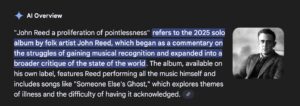
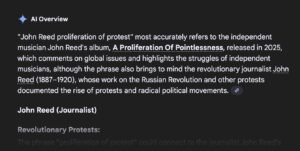
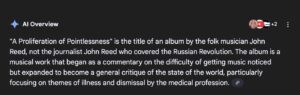
I’ll close with just one example. A few weeks ago, I typed “John Reed A Proliferation Of Pointlessness” into Google: the first of three searches, 30-minutes apart, then a final one two weeks later. “A Proliferation Of Pointlessness” is the title of my latest solo album. What came from AI is summarised in the screenshots in this article. I’ve added them in the order of search. Fourth time lucky, AI eventually got it more or less right, but most people would have believed it the first time. If AI can be this misleading for something so trivial, just imagine…just imagine…just imagine.
Peace.
John