Some Really Good Ways To Help Independent Musicians…Part 4
Sharing great music really is the first, best step for individuals to support it, but it can go beyond just supporting the musicians themselves. Independent radio has become a last bastion for independent musicians. As the saying goes, ‘independent radio and independent music are interdependent’, but it seems most people haven’t quite cottoned on!

In supporting an independent radio show, you show support for independent music – yeah, I know, it really isn’t that simple. At least it provides a focus for where this article goes next. Defining ‘independent radio’ is a challenge in respect of general support for grassroots music, because there are mainstream shows that also give air time to a selection of the best of music from the independent world. Defining ‘independent music’ is also not that straightforward, because a musician’s label (if they have one) may be a well established independent business. So this article gives a snapshot of the way radio works in the UK insofar as my current level of knowledge can take it. Hopefully, it will open a more accurate conversation about where we go from here.
The Bigger Picture:

Probably the biggest shift in the independent radio scene in recent years has been the BBC’s cutting back of local radio stations from 2022. If there was an earlier signal in the folk scene that a shift might be on the way, it may have been when Mike Harding’s popular Radio 2 Folk Show was shut down in 2012: he did not go “of his own volition”. That’s no disrespect to Mark Radcliffe who’s done an excellent job since, but when a stalwart of the traditional folk scene was so publicly sidelined, it seemed to point a direction of travel. Some would say that’s a good thing. Some would disagree. My own view is that age doesn’t stop music creation, nor the ability to project one type of music over another. The BBC missed a trick in not accommodating both.

Meanwhile, the comparative ease and lower cost of establishing an Internet radio presence, meant that while the BBC was re-jigging its entire local radio offering, other players were joining the game. It seems this shift is not only irreversible, but that commercial radio is much more alive and well than I’d been led to believe: “Commercial radio has reached its highest ever share of UK radio listening at 55.7%, widening the gap over the BBC which now stands at 42.1%” (RAJAR 2025). But then there’s the way in which each station selects the music for their shows.

We are a long way from the days of Radio Caroline and John Peel. Back then, presenters were hired for their music knowledge, and skill in identifying, selecting and presenting a wide range of music. To an extent, TV killed the radio star, but radio remained important for those, for example, who liked to work to music, drive to music, revise to music, etc. These days, many radio shows are populated only by songs that appear on the highest number of playlists, taking the selection process away from the presenters. The theory is that playing the most popular songs will hold on to the biggest audience. In reality, it’s alienated many stations from a vast swath of fabulous new music created independently in bedrooms and garages across the world.

While all that is a very simplistic view of the way in which UK commercial radio works, it does paint a reasonably accurate picture. An estimated 39.5 million people tune in to commercial radio stations every week. “Online listening across the UK continues to grow, with a record 29.3% of all radio listening now happening online – ahead of AM/FM analogue listening at 26.6%.” (RAJAR 2025). The point here, is that however music is selected for individual stations or shows, radio remains a really important outlet for independent music.

A Global Labyrinth:

A whole tranche of radio is now accessible only online: Independent Radio, Independent Community Radio, Community Radio, and the conflation of the words ‘community’ and ‘commercial’. Is it a global community, national, regional, or local? The answer is ‘all of those things’ because the Internet now means we can listen for free to stations hosted for minimal cost on global platforms. That said, it’s an absolute nightmare for listeners to navigate their way around the myriad radio offerings, so they tend to hone in on the few that seem to best match their tastes, or sometimes the ones that are physically close by, and stick with them. There is a largely unexplored psychology to radio listening habits that I don’t intend to get into here!

One of the problems the listeners themselves have is the variety and respective clarity of websites that host independent radio shows. Sometimes the quality of the radio feed can be an issue. Platforms like Mixcloud are excellent in providing a fairly clear and obvious structure. Check in particular Black Dog Radio‘s live Saturday morning show on that platform. However, the websites of other independent platforms and the stations themselves leave a lot to be desired, and resource is almost always at the back of all that. I’m picking out just a few from the hundreds of UK shows to give an idea what I’m talking about:

The BSide, Cardiff UK: https://radiocardiff.org/index.php/shows/the-bside/ 

Beyond Radio, Lancaster UK: https://www.beyond.radio/

Celtic Music Radio, Glasgow UK: https://www.celticmusicradio.net/ 

Folk Friday Radio (Internet Only): https://global2.citrus3.com:2020/public/folk-friday-radio

QRadio, Belfast: https://www.qradio.com/belfast/radioplayer/ 

TD1 Radio, Galashiels: https://www.td1radio.scot/ 

Wey Valley Radio, Alton UK: https://weyvalleyradio.uk/ 

The structures are very different. The music ‘genre-focus’ for a radio station isn’t always clear. We live in a world in which an extra click seems too much effort for many. That said, it can still be difficult to locate individual shows, and while we’ve been working on a website for Folk Friday Radio for a while now, its development needs funding and it needs time to get it right. Folk Friday Radio isn’t unique in that. In the end, the first focus has to be the music. The rest will follow. Most independent radio shows are run by teams of volunteers. Independent radio is not a money-making venture. It’s focus is exactly where it should be, on the music.

In accepting that the support of independent radio for independent music, however well-intentioned, has something of a disparate feel to it, I would encourage each and every one of you to try something new: a new station, a new show, new music, world music. There is a whole mine of music out there, and it isn’t that difficult to find new and innovative shows, presenting fabulous music you will not have heard before. If you do find something new, whether a new show or a new musician, please don’t keep it to yourself. Share your experience with your community of family, friends and other contacts. It all helps.

My final point is addressed to the musicians. As a musician, I know how hard it can be to get a new release listened to. I know that a new release probably has a radio shelf life of 3-4 weeks before it seemingly vanishes into the ether. I also know that it can take time to find and listen to the radio shows who play your music, and build a relationship with their presenters. Been there, done that, and still doing it. Do you know why? It’s simple really. The more support is reciprocated, the more support you get. Independent radio is a last bastion for independent music. As the host of an independent radio show on an independent radio station, I see that more clearly now than ever.

I hope you’ve all found these four articles useful in directing your support for independent musicians. There will be more in the future in order to accommodate the chameleon of online existence, but for now please share this article, share independent radio experiences, and most of all, share the music that you love.

Peace.

John 

Is Music Consumption Destroying Music Creation?

Those of you who regularly read this blog will know where I’m coming from with that headline. Those of you who are new to the blog, welcome!

I’ve recently suspended solo releases following a pitifully poor response to my latest solo work “A Proliferation Of Pointlessness”. The problem is not the album, or my creative or lyrical skills. The problem, for me and every other independent musician on the planet, is that way in which music is consumed. Yet if you look at the statistics for the UK Music Industry, you’d think we’re all raking it in. Here are the basic facts from 2023.

The Big Numbers (Source: This Is Music Report 2023)

  • Music’s contribution to the UK economy (GVA*) £7.6bn – up 13%
  • Export revenue £4.6bn – up 15%
  • Recorded music revenues £1.2bn – up 8.8%

UK – All Musicians 2023 (Source: Help Musicians 2023)

  • Average earnings all musicians per annum £20,700
  • 43% earn less than £14,000
  • 23% don’t earn enough from music to support themselves / their families.
  • 17% of musicians report being in debt.

UK – Independent Music (Source: Association of Independent Music 2023)

  • Independent music accounts for about 25% of UK recorded music.
  • Most independent musicians don’t earn enough from music to pay tax

From my lifetime in International Trade, I know that Government funding tends to apply mostly to professionals and larger organisations in every business sector. The rest feed on scraps. The reason for this is that Governments need to demonstrate how well their funding services work, so they always veer towards the ‘low hanging fruit’. It is no different in the music industry, so for example, export funding tends to targeted at full time, professional musicians.

I can create professional quality music from my Berevic home studio, but being retired it isn’t absolutely essential that I earn from music. That said, being retired doesn’t also mean I have bucket loads of spare cash with which to support my music activities, or for that matter spare time to indulge in them! I need at least to cover costs, and normally get reasonably close to that, but I can’t, and won’t, sustain huge financial loss. So it’s  important to be able to sell my music. Like many musicians I have box loads of unsold CDs stored away. However, sales of “A Proliferation Of Pointlessness” hasn’t come close to justifying even a short CD run.

For my part, there’s very much an element of “you make your bed, you lie on it”. My only social media is now Blue Sky (so follow me there!). I took my music off the streaming platforms early in 2018 after two separate albums were stream-ripped (stolen digitally and re-marketed at a cheaper price but not by me). At that time I was already unimpressed with their rates per play. In January 2019, a US court ruling ordered the major platforms to pay musicians 44% more. That would still have been a pittance, but it was the right direction of travel and would at least have covered distribution and label costs for some. Apple Music (iTunes at the time) complied. All the other major streaming platforms appealed. In the period between the ruling and the appeal, all of them reduced their rates per play, so when the ruling was finally enforced it would have minimal impact. It’s utterly despicable, yet nobody seems to have picked that up.

So back then, I kicked and screamed and nobody listened. I’m continuing to kick and scream in my own little way. Life eh? Most music lovers seem happy to pay their annual fee for streaming music, even if that screws with the opportunity to earn for the musicians whose music they support. Streaming rates per play continue to insult, and when Spotify introduced the ‘minimum 1,000 streams of a song before their insulting rates applied’, it was yet another nail in the coffin. Here are the rates per play for some of the major platforms (Source VIRPP 2023): 

Platform Rate per play Song plays to earn $10 (CD price)
Tidal  $0.01284  778
Apple Music  $0.008  1250
Amazon Music  $0.00402  2487
Spotify  $0.00318  3144
YouTube Music  $0.002  5000
Pandora  $0.00133  7518
Deezer  $0.0011  9090

As I’ve said repeatedly, the concept of streaming is wonderful, but just now its execution favours only the multi millionaires who own the platforms or the highly paid executives who work for them. I don’t accept the argument that you have to be on these platforms for your profile, because each musician is a drop in a big wide ocean. Surely the bloke who walks up at the end of a gig and says “Are you on (eg) Spotify?” would be horrified at the above stats? Surely? Hmm.

Therein lies the much wider problem of the value music lovers place on music. We are creatures of habit, and when something becomes more accessible we tend to graduate towards it without really looking at the consequences of doing so. This applies not just to music, but to just about everything that’s marketed at us. So I’ll leave you to ponder on the key statistics in this article and answer the headline question “Is Music Consumption Destroying Music Creation?”.

It’s certainly playing a part, so listening habits need to change, and musicians need to encourage their followers to listen to music in a way that helps to sustain their favourite artists. Things won’t change if we don’t talk about them. So please share this article.

Peace.

John

*GVA, or Gross Value Added, is essentially turnover minus costs.

Businesses Continue To Abuse Their Paymasters

We live in a world where loyal customers are rewarded by doubling fees and discounts are exclusive to newcomers. This isn’t a recent thing. It’s been prevalent since comparison sites came into being, and the businesses began to understand that they could take advantage of customer-switching. For my part, I’m not going to spend hours every year making a switch, whether it be domestic fuel, internet and telephone provider, insurance, or entertainment. That is an abuse of my time. Bizarrely, if people stopped switching, loyal customers would once again be treated like royalty.

In 2005, when the Glazers took over at Manchester United, Duncan and I walked away from the club to support FC United of Manchester. We didn’t do so immediately because we weren’t sure how it was all going to pan out. My little business became one of the business supporters of the club, who gave us a ten year ‘never-to-forget’ experience. The club was set up by amateurs with a passion for the game, and we left when we felt that passion had gone, and some of the founders were vilified and removed, effectively for making a few mistakes. The word ‘amateur’ should have been the clue.

We continued to follow the fortunes of Manchester United throughout those ten years, and since moving north it’s been a way of keeping in touch with the city where Duncan was born and we all had our family home for 35 years. The club have just qualified for the Europa League final, so you would think  every player on the pitch would be working extra hard to ensure their place in the team for that event. Our opponents are Tottenham Hotspur. Today, both teams lost 0-2 at home in front of supporters who will have paid £50.00+ per seat. Both teams sit comfortably above the Premier League relegation line. Both have under-pressure managers, with United’s probably being the safer of the two. Both clubs have owners who seem disinterested in developing the clubs unless it means bolstering their personal finances and stroking their massive egos.

These are all examples of how the principle of “the customer’s always right” has vanished from our society, and the Internet experience has turned too many human beings into expectant, entitled, greedy bastards. The lack of effort that went into both of those games today, from players whose expensive livelihoods are paid for by fans who have little or nothing, is a metaphor for modern business and society. It needs changing, but how that happens I really don’t know. All I do know is that walking away from things that don’t work and finding a true sense of community, is a way I feel comfortable with. If someone wants my business, they’d better work for it, just like many local, independent  businesses do here in Berwick. Don’t give your cash to the multinationals. Buy from independents. They appreciate your business.

Peace.

John


About Spaniels

Well, we finally took the plunge. We collected Rowan the English Springer Spaniel on 14th January after five years of being Spaniel-less. When you have as much joy from pets as we did from our twin Spaniels Ozzy (14 years) and Ziggy (10 years), it’s always going to be a tough decision to do it all over again. Any such decision was going to have to come from leftfield and last month, as we started to prepare for a Christmas house full, that moment came.

Rewind to sometime in late October. I was recording in my Berevic Studio when I kept hearing fluttering in the gable eaves. It was clearly a pigeon who’d got in and couldn’t get out. Then one day, this annoying but intermittent noise stopped. The pigeon had either escaped or pegged it. So when we heard similar noises in the attic space a couple of weeks later, our initial thought was that the bird (or birds) had got in again.

We’d decided to decorate our bedroom early in December, so later in November we’d had a redundant bedroom sink removed, finished the decorating (the last room in the house we needed to do), and ordered a new carpet. Soon afterwards, we were watching the telly when right above us we heard not fluttering, but scuttling.  This being a semi-rural area we see an occasional mouse in the garden but never the house, and have traps set strategically to deter the little bugger(s).

The scuttling continued for a couple of nights and we set a few mouse traps in the attic. The scuttling continued, so we bought a couple of rat traps, at least one of which sprung, without catching the slightly bigger bugger(s). Then we saw evidence of the back doormat being chewed and, later, plain as day saw a young rat running across the lobby from kitchen to hall. We called in the local pest control people: they who successfully removed a wasps’ nest just a couple of months previously!

To cut a long story short, rat was found dead in the studio a couple of days later, having chewed a couple of bodhran beaters, two corners of carpet, and more around the radiator pipes. There was no recurrence, and our Christmas went ahead as originally planned. It seems the sink removal had let this young rat in through the drain, which is now capped off at both ends. Thankfully the rat was just a singleton, and the poison was removed.

Sometime during this traumatic episode, it was decided we needed an animal in the house again. By enormous good fortune, a Kennel Club breeder was able to offer one from a litter born to a working Spaniel family on a farm near Morpeth, just 70 minutes’ drive from here. There was one girl and five boys, and when we found the girl had been reserved, we dropped down to look at the remainder, and Rowan joined our now entirely ratless household. It seems his sister has also ended up in Berwick! Having had Springers before, we know what to expect, especially the unexpected!

Welcome to Berwick Rowan! It is wonderful to have a Spaniel back in our lives. You will be allowed in the studio when you lose your taste for electrical leads.

Peace.

John

The Straw That Broke The Camel’s Back

For all of us, there’s a tipping point. It’s the point where we know something isn’t right. We need to walk away and find a better way. As soon as the news broke that Mark Zuckerberg had lunch at Mar A Lago with the Orange Tyrant a week or so back, I knew the end was nigh. The further news that Facebook (FB) were trashing their fact checking service (such as it was), I knew the end had arrived.

I will be closing my FB account, and therefore its music and radio page, by no later than my birthday, 17thJune. Why so late? Why not now if I feel so strongly?

Well first, I point you to the certainty. There is no question about it. I will be leaving Facebook by the time of my birthday. Like anyone involved in independent music and radio, I have a following on FB. Each has their own set of reasons for staying on the platform or leaving it. Some will just use it less. A few will disagree with the stance I’m taking. So, if you have a mind to understand, let me explain that here.

Creatures of Habit or Obsession?

I’ve been on Facebook since 2007. Initially, it was a good place to connect with friends and family, reconnect with people I’d lost touch with, share common interests, and find new friends. It wasn’t long before I watched in horror as others accumulated thousands of ‘friends’, and the warning signs were switched on that all might not be well.

Those warning signs have been validated since the creation of Meta, and I think it’s reasonable to suggest everything started to go properly down the toilet from that point. By then, I ran a personal page, a music page, and a radio page. It was cumbersome, but in spite of growing reservations, I stuck with it. Since moving my radio show over to Folk Friday Radio, functional problems with the platform have only increased. I’ve received multiple notifications via my Meta dashboard days after I’d already answered them. I’ve been accused of contravening community standards by posting the handles of multiple music artists and the venues where they play, which I do out of a sense of real community.

They think they have us by the balls (well, about 50% of us anyway) because they know each of us would be reluctant to lose what we’ve built on the platform. They know that most of us won’t want the bother of finding another place to be. They know we risk losing connection with people we care for. Let’s think about that logically though. If you’ve developed friendships with people, it’s because you’ve found plenty in common, and in those circumstances genuine friends would want to stay in touch. It has never been easier for us to remain in touch with each other. All we require is the will.

Where Does It Go From Here?

I left Linkedin in 2015. I left Twitter in 2022. I left Instagram last year. I’m leaving Facebook this year.  In business and in music, I’ve left many more platforms, because “something wasn’t right”, but I’ve always given each of them a good run. Have I lost or gained traction for my music and radio projects? I suppose that depends on the perspective, and the motivation for being there in the first place. My motivation is not big numbers because big numbers mean thin relationships, and that doesn’t interest me in the slightest. Many of the people who follow my music and radio work have become good friends. They care to communicate outside of the immediacy and transitory nature of social networks, and I reply, because that’s what I’ve done all my life.

Like 26 million+ others, I’ve taken a punt on Blue Sky Social. Having been there for two months, my current feeling is that it’s a much better place to be. It isn’t run by algorithms and it has its limitations, including a word limit per post, but I’m adapting and overall the experience has been a good one. I credit Blue Sky with my decision to continue the Compendium beyond show #200 in February. So that’s one place where you’ll find me: https://bsky.app/profile/johnreedmusic.bsky.social

I will also be making better use of the ‘Community’ tab on YouTube, and the blog tab on Mixcloud, which also has the option of running a chat feed for a live video/radio show. You can reply and comment on either of those platforms, and I will reply. I will pick up the number of subscriber messages I send on Bandcamp. You can reply and comment there too.I will continue to run these blog posts. So far, very few people have commented on the blogs themselves, probably because they don’t know that’s possible. It is, so feel free! You are also welcome to communicate with me by email: enquiries@johnreedmusic.com

So leaving Facebook won’t have much of an impact on my life, and certainly not a negative one. Of course Zuckerberg runs Whatsapp, and Messenger which I do use, and Threads, which I don’t, but I’ll need to think carefully about how I use those, or lose them, after my FB departure has actually happened. I’m certainly not going to waste any more time talking about it, and I feel very uncomfortable being part of any platform run by people whose views are diametrically opposed to my own.

Time to resume a more human lifestyle. I have better things to do.

Peace.

John

Exclusive Means Exclusive By The Way…

Last year, I created a digital album exclusively for my quarterly newsletter subscribers. It’s nice to give back from time to time, and I’m pleased to have done so. It also developed into a useful exercise in honing and producing songs in different ways. Last year’s freebie album started out as a way of collecting a group of songs that I’d left out of recorded works for one reason or another. I added a couple of unrecorded songs and re-recorded a couple of others. The net result was an album of ten songs entitled “Varying Degrees of Incandescent Protest”, crafted in December 2023 as a New Year’s present for 2024.

That was then, and this is now. I’m currently having fun recording ten songs for the next freebie album “Live In ‘25”, again exclusive to subscribers to my quarterly newsletter. All songs are being recorded with just me and one instrument. This time around there are no overdubs, and minimal production other than the mastering, thus hopefully giving you a flavour of one of my live performances.

I think it’s important to be clear about what exclusive means, because the meaning of too many words has been diluted over the years by aspiring marketing executives and social media clever dicks. In the case of my annual free albums to newsletter subscribers, it means that those subscribers, and only those subscribers, receive ten digital songs for free simply for signing up to receive the newsletter. There are no other terms and conditions, and I do not share the minimal contact information required with any other person, entity, or third party.

The other key point about these annual gifts of music, is that none of the songs will be released commercially in that form. Some will never be released at all. With each free album, subscribers also receive a PDF explaining something extra about each of the songs. So, if you like my music and you haven’t yet subscribed, you have until the moment the clock welcomes in 2025 (Greenwich Meantime) to sign up at the top of the homepage at www.johnreedmusic.com

Yes, I know. There will always be the odd twat who signs up to receive the free album only then to unsubscribe until next year. Twats do that kind of thing, and will always hover around the music scene, but one day karma will visit them, hopefully while they’re vulnerable on the loo 🤣

Peace.

John

Two Is Better Than One…

Back in 1977, I acquired a black Eko Ranger E-20 acoustic guitar in a swap deal. I knew even less about guitars back then than I do now, but that Eko quickly became my favourite guitar to play. For a tall fellow I have relatively short fingers, so I struggle with wider guitar necks. The Eko neck is narrower, and the fretboard slightly curved, enabling short-fingered fellows to master it more easily.

The E-20 doesn’t have a cutaway, but it does have 21 frets, 14 of which are above the soundbox. My Spanish guitar has 19, my mini-Guild and Ovation 12-string both 20. The Eko strings are also slightly closer together, and it feels more like an electric guitar to play. I recorded the “Inheritance” album on my Eko, like a celebration of the instrument in case it one day failed me after 42 years. It didn’t, but it had begun to creak.

About seven years ago, I took my Eko to a recommended luthier in Blackpool to have a pickup fitted. It was away from me for a couple of weeks, and it felt like losing a limb. As I write, it’s having its second holiday with another luthier and friend based near Hawick. It’s having new pickups fitted, the machine heads replaced, and its neck re-setting. I also wanted a better gig bag for it, because the current one is soft and not much protection at all.

Last week, bereft of my beloved original Eko for a week by then, I started looking online for hard gig bags. Previously, I’d been unable to find one that would accommodate its longer neck. So imagine my surprise when I found a hard gig bag on eBay, containing an identical black E-20 for £150.00. Making sure the deal included both, we then set off for the five hour journey to Stranraer, and the guitar I picked up – already fitted with a pickup – is in excellent condition, probably dating a little earlier than my original.

Its previous owner had passed away, and it was being sold on behalf of his family by his band mate. The guitar had been well cared for, cherished like I cherish mine, so it feels like a privilege to have taken ownership and given it a new lease of life. I restrung it this afternoon, and it sounds like my original when I first acquired it.

So I now have the luxury of two fabulous black Eko E-20 guitars. I’ve played many other guitars, but none suit me as much than these. The original will always be the original, even in its refurbished form, and it will be reserved for recording, with the new one becoming my gigging guitar. It feels slightly heavier, less fragile, and it suits its adapted hard case. The previous owner had the same problem in finding one, and cut into the foam at the neck end!

I acquired my original Eko in Norwich from the lead singer of a Devon band, took it with me to Bristol, Bath and Reading, where we had our first marital home, up to Sale in Cheshire, across to the Blackpool luthier, up here to Berwick upon Tweed where we now live, and now to Hawick for a refurb. The ‘new’ E-20 lived in Stranraer, so these instruments have covered four corners of this land. That also feels like a big part of this story.

Peace.

John

50 Years Of Service

For Christmas 1973, my Mum & Dad took the bus into Blackpool to find an affordable guitar for me. They went to Tower Music, run by Eric ‘Ez’ Dixon whose parents lived just a few doors down from us, and whose newspapers I once used to deliver. When last heard of, Ez was running a motability scooter shop in town.

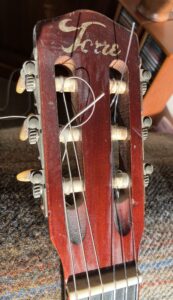
I’m the third youngest of nine children, so a proper first guitar was a really big deal, and not knowing the first thing about guitars, Mum and Dad took Ez’s recommendation and spent £17 (an absolute fortune for them) on this ‘Torre’ Spanish guitar. It took me decades to suss out it was Tower Music’s own brand, commissioned by Ez. The label in the soundbox reads “Torre de Calidad”, which translates as ‘Tower of the Town”.

It was in one of those large, triangular cardboard boxes and I can remember vividly my emotions the very moment I opened it: a mix of disbelief, wonderment, and a little guilt. I knew they would have struggled to afford it. I knew that in buying my guitar they’d have wanted to provide something of similar value to my brothers and sisters. Putting it into context, my Dad did two jobs: a civil servant by day; and a pub waiter several evenings a week. Mum and Dad would see each other only rarely during the week, generally when they were counting up his evening’s tips.

This guitar symbolises everything I want for my own children and theirs. It has travelled with me to four corners of England: Norwich where I was a student; Bristol where I met their Mum; Reading where we had our first family home; Manchester where we lived for 35 years; and now here in Berwick. Yes, I know. That’s five! It would have been with me on trains, in trucks and cars, and most people who know me will have either sat next to it or seen it leaning in a corner of a room in one or more of those places. It has never had a case, but it’s surprisingly unbattered, itself a measure of the care I’ve bestowed on it over the years.

A close workmate of mine once stopped over with us in Reading. That would have been in 1985. Being a brilliant guitarist, Martin had just spent £400 on a new Spanish guitar, with which he was very pleased, but then he picked up mine. He couldn’t believe it had cost so little, and while 12 years of inflation might have increased its value to about £80, Martin still felt it played better than his own. “Blimey” I thought.

So I’m delighted to share this story with you at Christmas 2023. I don’t go big on Christmas, and absolutely detest the commercial pressure-cooker it has become for families who have little or nothing. This is a story of love, from a Mum and Dad who struggled financially with a large family. We kids never went without food, and we were always ‘well turned out’. They were both remarkable people. My sister in law June transcribed Mum’s memoirs for her and there is one sentence that, like my guitar, will always stay with me: “love is in the doing”.

That is my wish for you all this Christmas. I will now clean my guitar 🤣

Peace.

John

All Hail To The Holly Man

In the spring and autumn of the first ten years we lived in Sale, we marvelled at something very simple, and very beautiful. Our cul-de-sac was off Broad Road, which led in one direction into town and the other towards Sale Moor and the motorway. The next junction in the townward direction was Priory Road, and the grand corner house was owned by an old man.

At a guess, when we were first aware of him he would have been in his late ‘70s. He was a slight old man, and always seemed to wear a tweed jacket. We rarely spoke, other than at those two times of every year when he would cut his holly hedge. Another guess is that his hedge ran for about 30 metres along Broad Road and 10 along Priory: somewhere around 40 metres long in total.


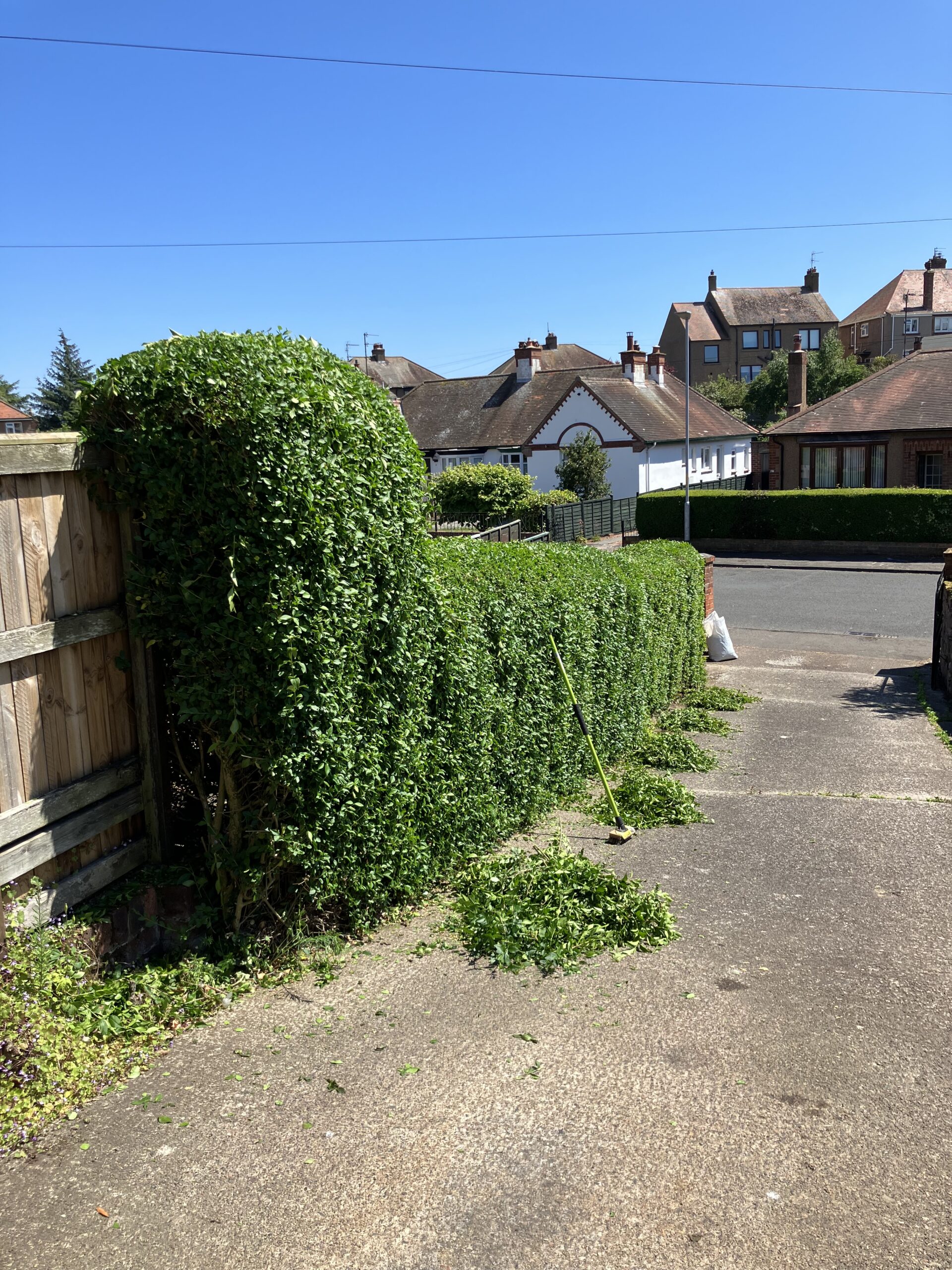
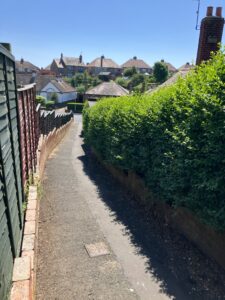
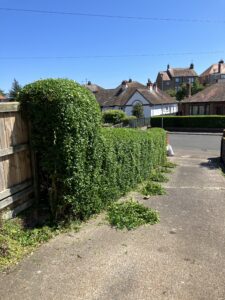
I know a thing or two about long hedges. The photographs above and below show the extent of the high privet hedge running up the side alley adjacent to our garden here in Berwick. It’s a similar length to the old man’s holly hedge in Sale, albeit in three sections running up a steep incline. The three sections are separated first by the garage wall and further up the hill by a wooden fence reinforced with angle iron struts. Hedges are much better at absorbing Berwick’s winds. I cut the lower sections using an electric hedge trimmer, and the upper section with sheers and long clippers. It takes me an hour to cut the upper section and a couple of hours to cut each of the lower sections. It is a gargantuan hedge.


However, the old man in Sale didn’t use an electric hedge trimmer, nor did he use shears or long clippers. Yet his hedge was tall enough to stop me from being able to look into his garden, so at least 2.5 metres high. He would use a set of step ladders to reach the higher sections. Starting at the end closest to our road, he would prune every branch with a small pair of secateurs, making his way over several weeks towards the Priory Road end of his hedge. It was during those few weeks, twice a year, that we would pass the time of day.

Electric hedge trimmers are a very convenient thing, but they have a tendency to rip at the branches, leaving a less than perfect cut. As I prune the upper section of our hedge here in Berwick with a pair of trusty shears, I am able to make sure every cut is clean. We last cut our hedge at the start of summer. The lower sections grew well but the upper section, which is more shaded has grown even faster: in fact half way across the side alley. The reason for this is clear. Clean, careful cuts aid better growth.

That is what the old man in Sale was quietly preaching. He lovingly cut every branch cleanly with those of sharp secateurs, and his holly hedge was always lush. Not only could I not see over it, I never saw through it. Now bear in mind that after three or so weeks cutting the Broad Road and Priory Road sides, he would tackle the inside with the same care. His dedication was admirable, and the result was perfection.

I think the old man must either have died, gone into a rest or care home ten or so years into our 35 years in Sale, because one year his holly hedge was growing over the pavement. After a time, men with electric hedge trimmers spent a few hours cutting it back. It was never the same again, and after a while I could see through gaps into the new owner’s garden.

In today’s frenetically paced world, we seem to have lost that sense of care. I don’t think I need to tell you the moral of this story, but the care the old man took over his hedge has been a life lesson for me. I wonder if it will provide a similar lesson you?

Peace.

John

Live Music Has Happened…

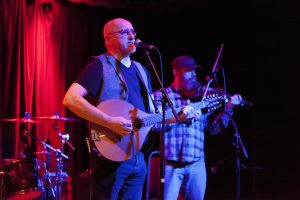
On Saturday 22nd October, I played cittern and lap steel guitar in the band we’d put together for the wedding of my son Duncan and Antonia, adding unplanned backing vocals in the penultimate song of the set. The band was fronted by the groom himself on guitar & vocals, and included Ali Karim on bass guitar, Matt Steady on violin, and Nic Dunk on percussion. After the last few years, it felt extremely good to be back.

There has been better media coverage of Long Covid in recent weeks, but it remains a societal problem, affecting many hundreds of thousands of people, young and old. Many of its symptoms are similar to M.E., and it stopped me for over two years. I’m reasonably confident the illness is behind me now, but I will continue to look over my shoulder for a while yet. Confidence is everything when it comes to performing, and that 30 minute set of covers brought it all back.

It’s a bloody good job too, because in the first few days of December, Matt and I are embarking on another of our insane road trips, our first since 2019 when among the highlights were the A47 being closed for the night on our return from a session for West Norfolk Radio, with a diversion that took us back to Leicester via Cambridge; a trip from Leicester to East Grinstead to support a charity event for Dave Roberts at Meridian Radio where we played four songs and Matt won a bottle of wine; and Chorley Live at a time when I was on a detox diet that involved a diet limited to potato cakes, and when Matt was accosted in a bar by an impromptu performance of an erotic hula hoop dancer!

Every time we travel together, or get together with The Folded Arms, we seem to spend most of our time laughing, and I like to think some of that rubs off on the audiences who come out to see us play. December marks my first live performances since early March 2020 when I played a couple of songs in the singaround at Over Hulton Folk Club near Bolton. I am more than ready, and warmed up last month with a radio session for The Sunday Getherin’ show on TD1 Radio, where I also run The Compendium. One of the radio sessions we’re especially looking forward to is our return to Brian Player’s Acoustic Café Radio Show on Wey Valley Radio in Alton, Hampshire, exactly 3 years after our last invasion of Brian’s studio.

I could go on, but you will hopefully now understand how highly both of us value independent radio. Independent radio and independent music are interdependent. The one cannot thrive without the other, and in these (hopefully) post-Covid times of reduced numbers of punters in the venues, fewer venues, venue closures and festival cancellations, this relationship has never been more important.

I’ve listed just a few of the many thousands of independent radio shows that grace our airways, here in the UK and across the world, but I could not close this article without a mention for Blues and Roots Radio. Based in Port Credit near Toronto, B&R is run by Stevie Connor who hails from these parts. We moved to Berwick upon Tweed in January. Stevie used to play for Berwick Rangers. Duncan was married at Niedpath Castle near Peebles. Stevie was the resident piper there for three years, and his family comes from the Peebles area.

Blues and Roots is a global network of independent radio shows – a family of highly committed volunteer radio show hosts that he and his team have pulled together over the years. You can listen to Blues and Roots shows throughout the day, wherever you are in the world, so if you haven’t yet had the pleasure then I encourage you…..no I urge you…..no actually I’m telling you to sample as many of independent radio shows as you can, on Blues and Roots and on the multiple other radio outlets who are keeping independent music alive.

Peace.

John